
Accessibility Tools

Skip to main content
About TINKER

About TINKER

TINKER (an auThentIc learNing and gender inclusive frameworK for tEaching infoRmatics in schools across Europe) project aims to revolutionise informatics education in upper primary and lower secondary schools through a comprehensive pedagogical framework. Rooted in authentic learning principles, the project encourages students to engage with real-life tasks, promoting exploration and intentional connections between theoretical knowledge and practical experiences. This pedagogical approach aligns with the latest JRC report that emphasises the importance of problem-solving and product creation in informatics curricula, as well as contributes to the EU’s goal of ensuring that by 2030, 80% of adults will possess basic digital skills and there will be 20 million ICT specialists across the member states.

The project also aims to address and overturn the severe underrepresentation of women and gender minorities in the field, by adopting a progressive gender-inclusive stance. In particular, it will promote gender-inclusive teaching practices creating positive student-centred environments that celebrate diversity. By addressing existing biases, TINKER aims to contribute to a transformative educational experience where gender diversity is not only respected but also valued as an asset.
Welcome

The TINKER (an auThentIc learNing and gender inclusive frameworK for tEaching infoRmatics in schools across Europe) project aims to revolutionise informatics education in upper primary and lower secondary schools through a comprehensive pedagogical framework. Rooted in authentic learning principles, the project encourages students to engage with real-life tasks, promoting exploration and intentional connections between theoretical knowledge and practical experiences. This pedagogical approach aligns with the latest JRC report that emphasises the importance of problem-solving and product creation in informatics curricula, as well as contributes to the EU’s goal of ensuring that by 2030, 80% of adults will possess basic digital skills and there will be 20 million ICT specialists across the member states.

The project also aims to address and overturn the severe underrepresentation of women and gender minorities in the field, by adopting a progressive gender-inclusive stance. In particular, it will promote gender-inclusive teaching practices creating positive student-centred environments that celebrate diversity. By addressing existing biases, TINKER aims to contribute to a transformative educational experience where gender diversity is not only respected but also valued as an asset.

About TINKER

TINKER’s overarching aim is to develop and implement an evidence-based, authentic learning pedagogical framework in teaching informatics, in upper primary and lower secondary education through a contemporary gender-inclusive approach.

The TINKER project aspires to achieve the following objectives:

{}

Promote the use of a pedagogical framework for teaching and assessing informatics on the grounds of authentic learning and contemporary gender inclusive practices, in upper primary and lower secondary education.

{}

Built up the capacity of teachers to create authentic learning environments, following gender inclusive practices when teaching informatics.

{}

Support mutual learning across Europe, and facilitate the adoption of evidence-based pedagogies in teaching and assessing informatics.

{}

Engage policy makers across the EU in discussions about informatics teaching and assessment to improve teacher practices and digital skills in Europe.

Outputs

WP1

Project Management

WP2

A Framework and Toolkit for Informatics Education

WP3

Teacher training for authentic and gender inclusive informatics education

WP4

eLearning platform, MOOCs, and OERs for teaching informatics

WP5

Pilot implementations and impact assessment

WP6

Scaling up and Sustainability

WP7

Dissemination and Exploitation

WP7

Dissemination and Exploitation

Methodology

To address the gaps in teacher training and teaching informatics, TINKER will use a five-stage design-thinking methodology enriched with action research and implementation science to ensure evidence-based policymaking. The project is committed to environmental sustainability and inclusivity and builds on three key pillars: Informatics Areas & Competencies, Authentic Learning, and Gender-inclusive Practices.

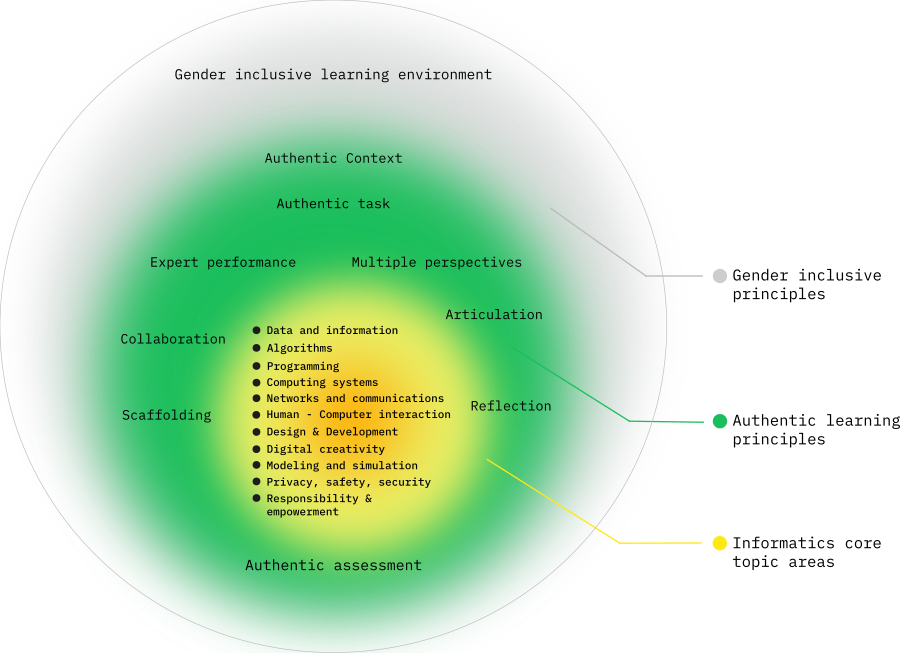
The TINKER project will develop an innovative pedagogical framework based on the elements in the diagram below:

diagram

The conceptual framework of TINKER

Informatics Areas & Competencies

TINKER bases its intervention on the Informatics Reference Framework for primary and secondary schools developed by the Informatics4All coalition to address the absence of a standardised informatics competencies framework. Derived from a comparative analysis of specific EU country curricula, the framework is the basis for the TINKER project which aims to enhance it with authentic learning principles and gender-inclusive practices.

Authentic Learning

TINKER adopts the authentic learning model. In this modern pedagogical approach, students actively engage in solving real-world problems. This approach includes principles like authentic context, task, collaboration, reflection, and assessment to move from rote memorisation to a practical understanding of informatics.

Gender-inclusive Practices

TINKER uses gender-inclusive practices informed by critical theory and pedagogy, feminist pedagogy, and intersectionality. It aims to promote awareness about gender diversity, assess gender bias, balance educational activities, use gender-inclusive language, provide accessible examples, and encourage open discussions. The goal is to foster motivation for computer science among all students, focusing on girls and gender minorities, aligning with the authentic learning model.

Partners

CARDET | CENTER FOR THE ADVANCEMENT OF RESEARCH & DEVELOPMENT IN EDUCATIONAL TECHNOLOGY (Cyprus)
cardet.org
CARDET

CARDET is the leading research and development centre in the Mediterranean region with global expertise in school education, digital skills, teacher professional development, and capacity building. As the largest independent non-profit centre based in Cyprus, CARDET is independently affiliated with universities and institutions from around the world, such as the Yale University and the International Council of Educational Media. The team, in partnership with EAEA, has recently developed the lifelong learning strategy 2021-2027 for Cyprus, engaging several ministries, government agencies, social partners, and public and private stakeholders. CARDET has completed more than 300 projects and initiatives relating to systemic school reform, digital learning transformation and evidence-based policymaking, delivering innovative toolkits, curricula and training, gamified eLearning spaces and MOOCS. CARDET brings together an international team of experts with decades of global expertise in education research and development Members of the team, board of directors, and advisory board have served in high profile positions for organisations like UNESCO, Commonwealth of Learning, OECD, Google, and the American Educational Research Association. CARDET is ISO 9001 certified for quality in management, research, and education services and a full member of ALL Digital, Digital Skills and Jobs Coalition.

EUN | EUN PARTNERSHIP AISB – EUROPEAN SCHOOLNET (Belgium)
eun.org
EUN

European Schoolnet (EUN), is the network of 34 European Ministries of Education, based in Brussels. As a not-for-profit, it aims to bring innovation in teaching and learning to its key stakeholders: Ministries of Education, schools, teachers, researchers, and industry partners. Its mission is to support education stakeholders in Europe in the transformation of education for 21st century digitalized societies. It does this by identifying and testing innovative practices, sharing evidence about their impact, and supporting the mainstreaming of teaching and learning practices aligned with 21st century standards for inclusive education. EUN use its links with education ministries to help schools become effective in the pedagogical use of technology, equipping teachers and pupils with key skills. EUN has experience both in new technologies (e.g. see Future Classroom Lab under “Description of infrastructure and relevant technical equipment for the proposed work” or its involvement in next-lab), and has managed over 30 pilot experimentations with schools across Europe (from setting up the pilots, to training, evaluating and coordinating). EUN coordinates and participates in many European and privately funded projects and is constantly researching trends in education and collaborating with public authorities, schools, teachers and industry to improve school education through mainstreaming innovative practices.

    Funded by the European Union. Views and opinions expressed are however those of the author(s) only and do not necessarily reflect those of the European Union or the European Education and Culture Executive Agency (EACEA). Neither the European Union nor EACEA can be held responsible for them. Με τη χρηματοδότηση της Ευρωπαϊκής Ένωσης. Οι απόψεις και οι γνώμες που διατυπώνονται εκφράζουν αποκλειστικά τις απόψεις των συντακτών/συντακτριών και δεν αντιπροσωπεύουν κατ'ανάγκη τις απόψεις της Ευρωπαϊκής Ένωσης ή του Ευρωπαϊκού Εκτελεστικού Οργανισμού Εκπαίδευσης και Πολιτισμού (EACEA). Η Ευρωπαϊκή Ένωση και ο EACEA δεν μπορούν να θεωρηθούν υπεύθυνοι για τις εκφραζόμενες απόψεις. Подкрепата на Европейската комисия за създаването на този уебсайт не представлява потвърждение на съдържанието, което отразява вижданията само на авторите и Комисията не носи отговорност за използването на съдържащата се в сайта информация. Tento projekt byl financován s podporou Evropské komise. Tato publikace odráží pouze názory autora a Komise nenese odpovědnost za jakékoli použití informací v ní obsažených Gefinancierd door de Europese Unie. De hier geuite ideeën en meningen komen echter uitsluitend voor rekening van de auteur(s) en geven niet noodzakelijkerwijs die van de Europese Unie of het Europese Uitvoerende Agentschap onderwijs en cultuur (EACEA) weer. Noch de Europese Unie, noch het EACEA kan ervoor aansprakelijk worden gesteld. Financirano sredstvima Europske unije. Izneseni stavovi i mišljenja su stavovi i mišljenja autora i ne moraju se podudarati sa stavovima i mišljenjima Europske unije ili Europske izvršne agencije za obrazovanje i kulturu (EACEA). Ni Europska unija ni EACEA ne mogu se smatrati odgovornima za njih. Le soutien de la Commission européenne à la production de cette publication ne constitue pas une approbation du contenu qui reflète uniquement les opinions des auteurs, et la Commission ne peut être tenue responsable de l’usage qui pourrait être fait des informations qu’elle contient. Die Unterstützung der Europäischen Kommission für die Erstellung dieser Veröffentlichung stellt keine Billigung des Inhalts dar, der nur die Ansichten der Autoren widerspiegelt, und die Kommission kann nicht für die Verwendung der darin enthaltenen Informationen verantwortlich gemacht werden. O apoio da Comissão Europeia à produção desta publicação não constitui um aval do seu conteúdo, que reflete unicamente o ponto de vista dos autores, e a Comissão não pode ser considerada responsável por eventuais utilizações que possam ser feitas com as informações nela contidas. El apoyo de la Comisión Europea a la producción de esta publicación no constituye una aprobación de su contenido, que refleja únicamente las opiniones de los autores, y la Comisión no se hace responsable del uso que pueda hacerse de la información contenida en ella. Finanziato dall'Unione europea. Le opinioni espresse appartengono, tuttavia, al solo o ai soli autori e non riflettono necessariamente le opinioni dell'Unione europea o dell’Agenzia esecutiva europea per l’istruzione e la cultura (EACEA). Né l'Unione europea né l'EACEA possono esserne ritenute responsabili. Podpora Evropske komisije pri izdelavi te publikacije ne pomeni odobritve vsebine, saj odraža le stališča avtorjev in Komisija ne more biti odgovorna za kakršno koli uporabo informacij, ki jih vsebuje.
    [Project Number : 101132887]

    Copyright © | Privacy policy